

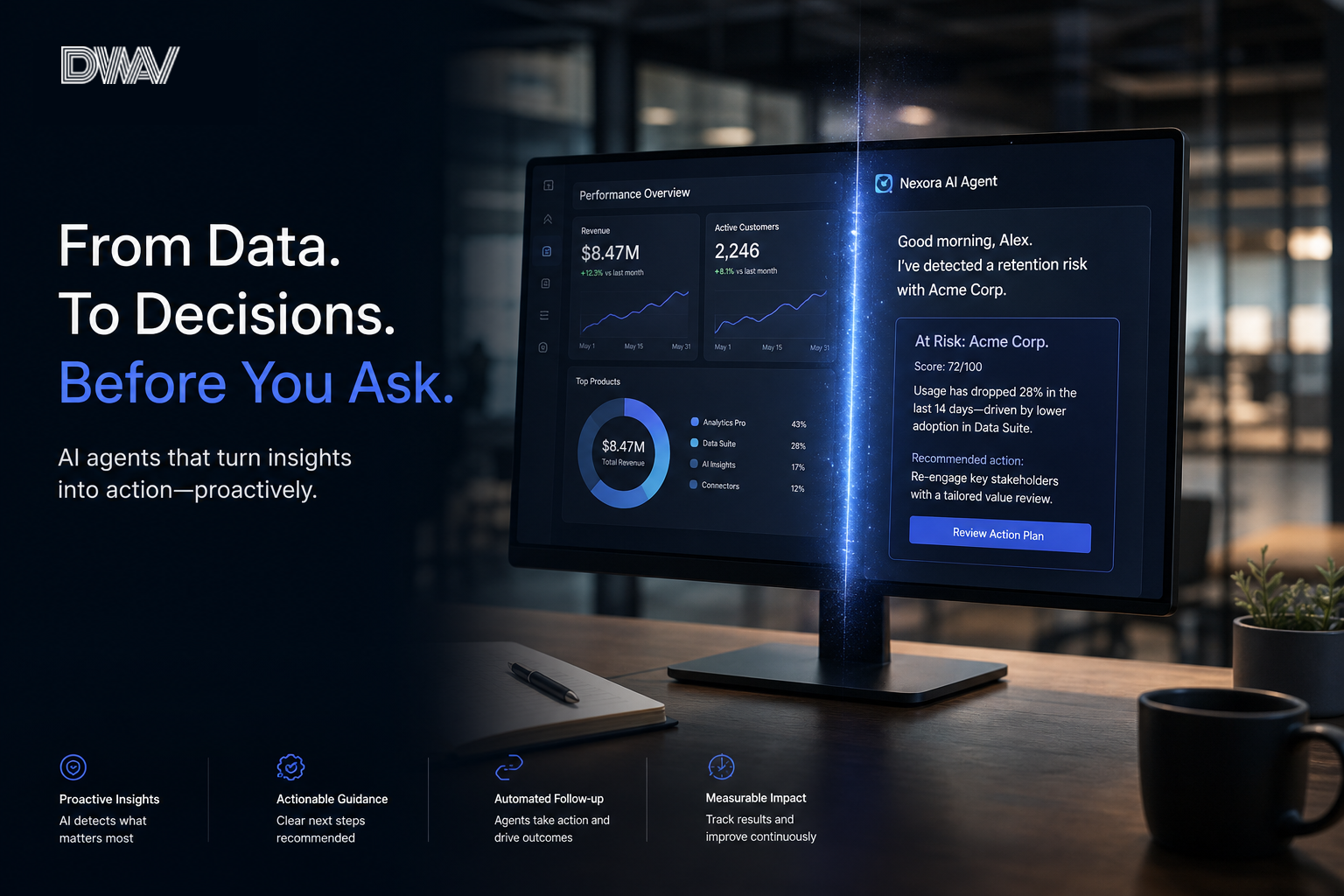
B2B SaaS AI integration in 2026 means embedding intelligent agents that monitor your data streams, explain anomalies, and deliver decisions to Slack or email before a human opens a dashboard. The winning products require the least screen time. They work in the background and surface only when someone needs to act.
I build AI solutions through DialWise AI and TrainR, and I ship custom agent layers for B2B founders who already have paying users on a dashboard-heavy product. Thirteen years in sales and marketing taught me what buyers actually renew. They renew outcomes. Chart libraries alone do not close renewals. This piece is what I tell owners evaluating whether to bolt AI onto an existing SaaS stack, as of June 2026.
What Is the Future of B2B SaaS AI Integration in 2026?
The future is agent-native software. Applications embed task-specific AI agents that watch metrics, cross-reference history, and push plain-language recommendations into the channels where decisions already happen. Gartner reported in Q1 2026 that 80% of enterprise applications shipped or updated in that quarter embed at least one AI agent, up from 33% in 2024. The buying question shifted from whether to integrate AI to which workflows justify the operating overhead.
B2B SaaS AI integration covers three layers. Data pipelines that stay reliable when token volume spikes. Agent orchestration that decides when to alert, draft, or execute. Guardrails that stop an agent from changing production data without approval. Skip any layer and you get a demo that breaks under real load.
This is a B2B product architecture guide. I am not covering consumer app chatbots or one-off ChatGPT wrappers. If you want the operational side for SMB workflows, start with my AI automation for small business guide. If governance is your blocker, read AI governance and data security before you connect write access.
Why Are B2B Teams Drowning in Dashboards?

Teams drown in dashboards because every new feature added another chart nobody owns. For a decade the default SaaS deliverable was a beautiful interface full of metrics. Executives logged in, scrolled, exported CSVs, and still could not answer the next question: what do we do about this number?
I see the same pattern on discovery calls. A founder shows me a product with fourteen dashboard tabs. Usage analytics say power users live in two of them. Everyone else gets a weekly email they ignore. The product succeeded at collecting data. It failed at converting data into action.
According to BCG and Forrester 2026 survey data cited across enterprise agent research, 41% of agent deployments report positive payback within twelve months. Twenty-two percent report negative ROI at the same mark. The failures cluster around scope creep, missing evaluations, and no named owner. Dashboard-heavy products often have the same disease. Lots of surface area, nobody accountable for the insight.
Dashboard fatigue is a product strategy problem. You built a telescope when buyers wanted a phone call that says turn left.
What Is Proactive AI Software vs a Passive Dashboard?
Proactive AI software watches data continuously and initiates contact when something needs a decision. A passive dashboard waits for a human to log in, interpret a visualization, and figure out the next step. One pushes. One waits.
Here is how I explain the difference to founders evaluating a rebuild.
| Dimension | Passive dashboard | Proactive AI agent layer |
|---|---|---|
| Trigger | User opens app | Anomaly or threshold event |
| Output | Charts and filters | Plain-language summary plus recommended action |
| Channel | In-app only | Slack, email, SMS, in-app |
| Root cause | User must investigate | Agent cross-references logs and history |
| Screen time | High for daily users | Low until approval is needed |
| Build focus | Frontend visualization | Backend pipelines plus orchestration |
Example from a client project. Their revenue dashboard showed churn risk scores. Nobody checked it until accounts were already gone. We added an agent that monitors usage drops, drafts a save offer, and posts it to the account owner in Slack. Time-to-intervention dropped from days to hours. The dashboard still exists for auditors. Daily work moved to the agent channel.
How Are AI Agents Rewriting B2B SaaS Architecture?
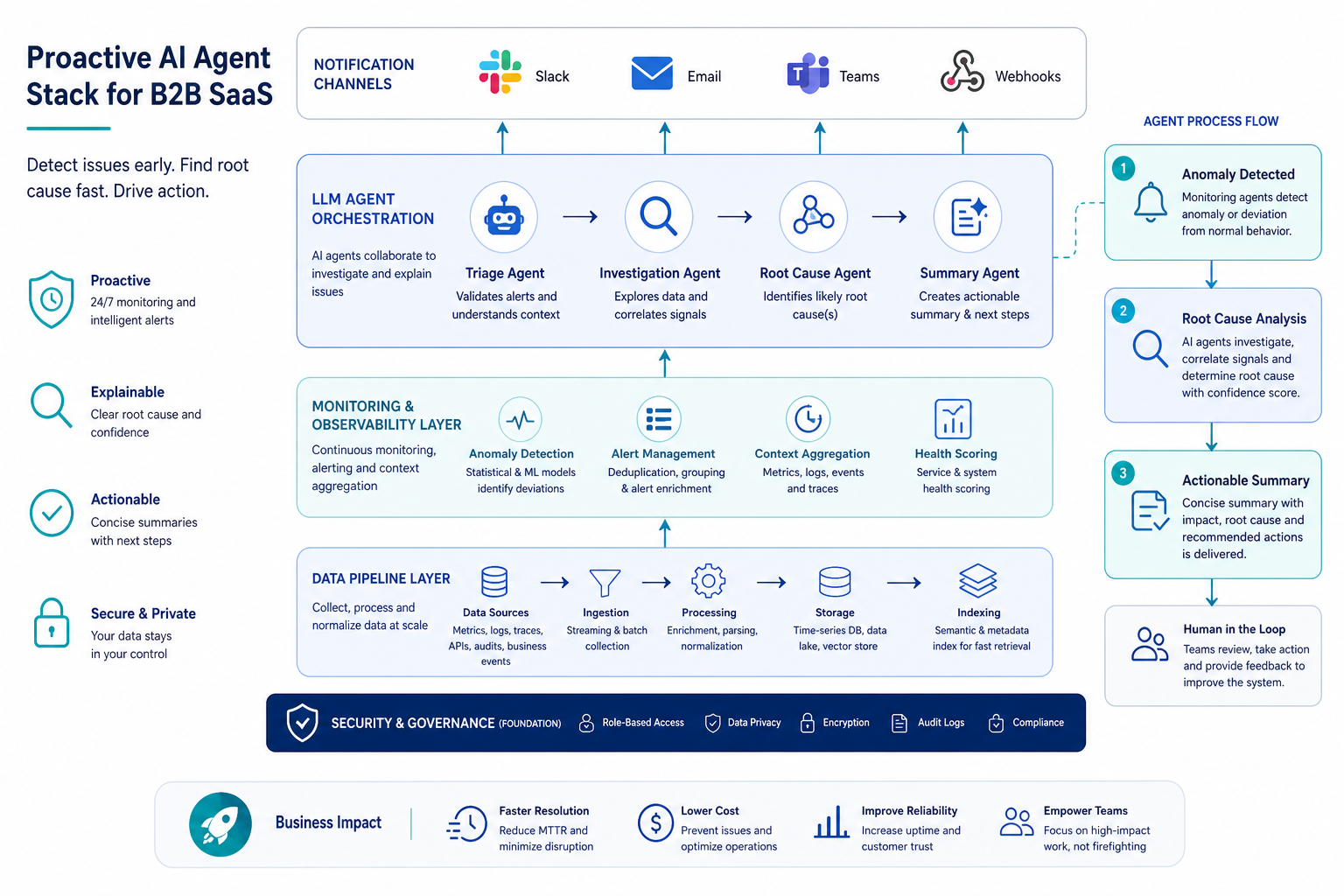
AI agents push compute and logic toward the backend. The frontend shrinks. The valuable B2B SaaS stack in 2026 has reliable event streams, a retrieval layer for customer context, an orchestration framework, and outbound connectors to tools where work already happens.
Gartner forecasts that 40% of enterprise applications will embed task-specific AI agents by end of 2026. Multi-agent orchestration is growing fast. Research tracking enterprise adoption shows multi-agent deployments at 22% in 2026 versus 1% in 2024. The integration pattern is no longer a single chat box. It is specialized agents coordinating across billing, support, and sales data.
When I scope custom app development for B2B products, I spend more time on data contracts than on React components. Can we get a clean event when a trial ends? Can we query account history without loading the whole database into context? Can we trace what the agent did last Tuesday? If those answers are no, the agent will hallucinate confidence.
Model Context Protocol adoption is the quiet signal here. Public MCP servers crossed 9,400 by April 2026 per industry tracking. Private enterprise servers likely run several times that number. MCP matters because it decouples tool integration from any single model vendor. Your B2B SaaS AI integration survives when the model provider changes.
Dashboard vs AI Agent: Which Should Your Product Bet On?
Bet on both, but lead with the agent for daily users and keep the dashboard for compliance, finance, and power analysts. Removing dashboards entirely alienates buyers who still need exportable proof. Building only dashboards leaves renewal risk on the table when a competitor ships proactive alerts.
| Scenario | Lead with dashboard | Lead with AI agent |
|---|---|---|
| Regulated reporting | Yes, auditors need fixed views | Agent supplements, does not replace |
| Operational alerts | Poor fit, too slow | Yes, speed wins |
| Executive weekly review | Still useful for trends | Agent sends summary before the meeting |
| Self-serve SMB buyers | Expected baseline | Differentiator if alerts are accurate |
| Enterprise procurement | Required checkbox | Proof of innovation for renewal |
Median time-to-value for agent deployments sits at 5.1 months according to BCG and Forrester 2026 data. Customer service agents often pay back faster. Finance and ops agents take longer because data cleanup eats the first sprint. Pick the workflow where a wrong alert is cheap to fix. Ship there first.
How Do I Integrate AI Agents Into an Existing B2B SaaS Stack?
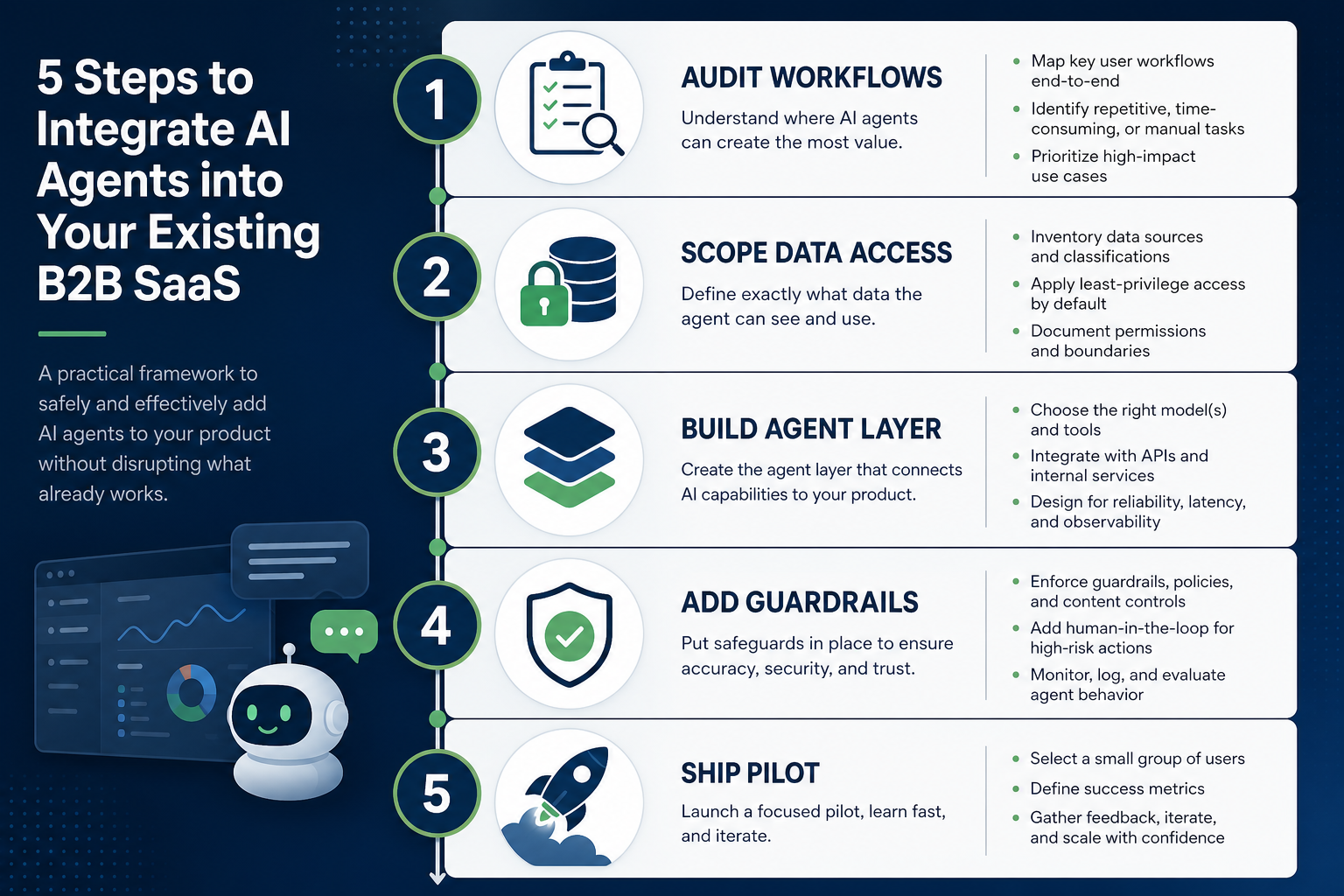
Start narrow, wire governance early, and measure one outcome before you add a second agent. This is the sequence I run on custom AI agent builds.
- Audit one workflow end to end. Pick the metric executives already argue about in meetings. Map every system that touches it. If you cannot draw the data path on a whiteboard, the agent will not fix the chaos.
- Scope data access by role. Agents get the minimum fields required. Retrieval collections are tagged by sensitivity. Same rule I use on governance-first projects. Customer PII and pricing logic do not live in the same bucket.
- Build the agent layer beside the dashboard. Do not rip out working UI on day one. Add event listeners, scheduled scans, or webhook triggers that feed the agent. Users opt in to Slack or email delivery.
- Hard-code guardrails. Prompts drift. Code does not. Block write actions above a dollar threshold. Require human approval on bulk sends. Log every tool call. Eighty-nine percent of teams with production agents report some form of observability per late 2025 engineering surveys. You need tracing, not hope.
- Run a thirty-day pilot on one segment. Measure time-to-action, false positive rate, and one revenue or retention input. BCG and Forrester data shows 41% of deployments hit positive ROI within twelve months. Your pilot should prove the workflow belongs in that bucket before you scale spend.
Connect this to workflow automation when the agent needs to execute, not just advise. Booking a meeting or updating a CRM stage is automation. Explaining why a trial stalled is agent work. Most products need both.
What Does B2B SaaS AI Integration Cost in 2026?
A focused pilot on one workflow typically runs $15,000 to $40,000 with a small engineering team or a specialist contractor. That covers discovery, retrieval setup, one agent, guardrails, and observability. Full multi-agent integration across a mature B2B SaaS product often lands at $75,000 to $200,000 depending on data mess, compliance requirements, and how many outbound systems need write access.
Ongoing costs matter as much as build costs. Median enterprise LLM spend grew 7.2x year over year by Q1 2026 per adoption tracking that aggregates Gartner and IDC inputs. Budget for tokens, vector storage, and eval runs. An agent that looks free in a demo can burn $2,000 a month in production if it queries wide and logs everything.
Cheaper paths exist. Wrap a single metric with a scheduled summary to Slack using existing APIs. That is a weekend project if your data is clean. The expensive part is never the model call. It is the plumbing, the permissions, and the proof that the agent is right often enough to trust.
Compare those ranges to the cost of a product team spending two quarters rebuilding dashboards nobody uses. I have seen that movie. The board gets a demo. Users keep exporting CSVs. An agent pilot on churn or expansion pays for itself when it saves one mid-market account.
When Should You Hand AI Integration to Someone Who Has Shipped It Before?
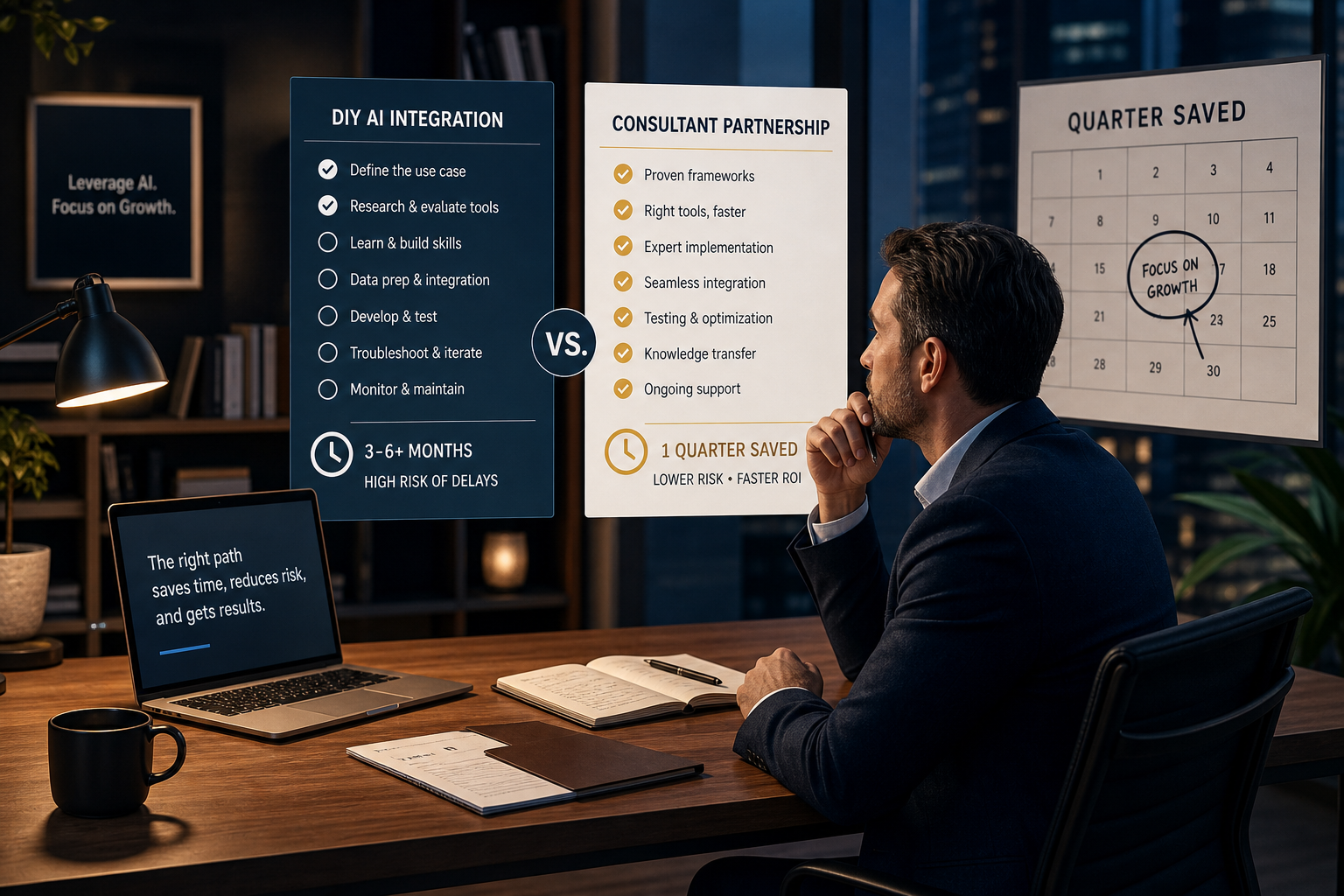
Hand it off when your pilot needs write access to customer data, when false alerts would damage trust, or when your team has been stuck in proof-of-concept for more than sixty days. Those are the lines between experimentation and product strategy.
You can wire a Slack bot yourself. You can turn on Copilot Studio or LangChain tutorials and learn orchestration. The slow part is designing retrieval scopes, evals, and guardrails that survive edge cases. Military intelligence and QA work taught me to treat silent failures as the default. An agent that books the wrong meeting is worse than no agent.
I am Etai Fishler. I help B2B founders and SMB operators ship AI that drives ROI without betting the customer database on default settings. I scope agent integration in the same call where we name the renewal metric the feature must protect.
Book a free 20-minute AI opportunity audit if you want a ranked plan: which workflow to agentify first, what to keep as dashboard, and what governance to lock before you scale. You can build it yourself. I am faster because I have already paid for the mistakes.
FAQ: B2B SaaS AI Integration
What is B2B SaaS AI integration?
It is embedding AI agents and automation into a business software product so the system monitors data, explains changes, and pushes actions to users without requiring them to open a dashboard. In 2026 it usually includes retrieval over customer data, orchestration logic, outbound notifications, and guardrails on write actions.
Are dashboards dead in B2B SaaS?
No. Dashboards remain necessary for compliance, finance, and deep analysis. Daily operational decisions are moving to proactive agents that meet users in Slack or email. Products that rely on dashboards alone face renewal pressure when competitors ship alerts first.
How long does B2B SaaS AI integration take?
A single-workflow pilot often ships in six to ten weeks. Median time-to-value across enterprise agent deployments is 5.1 months according to BCG and Forrester 2026 survey data. Full multi-agent rollouts stretch longer when legacy data needs cleanup.
Dashboard vs AI agent: which is better?
Dashboards are better for audit trails and trend review. AI agents are better for speed and action on operational metrics. Most B2B products need both, with agents handling daily alerts and dashboards serving power users and regulators.
What is the first workflow to agentify in a B2B SaaS product?
Pick the metric executives already debate in weekly meetings, where a wrong alert is cheap to fix and data sources are readable. Churn signals, trial conversion drops, and support queue spikes are common starting points. Avoid finance close and billing writes until guardrails are proven.