
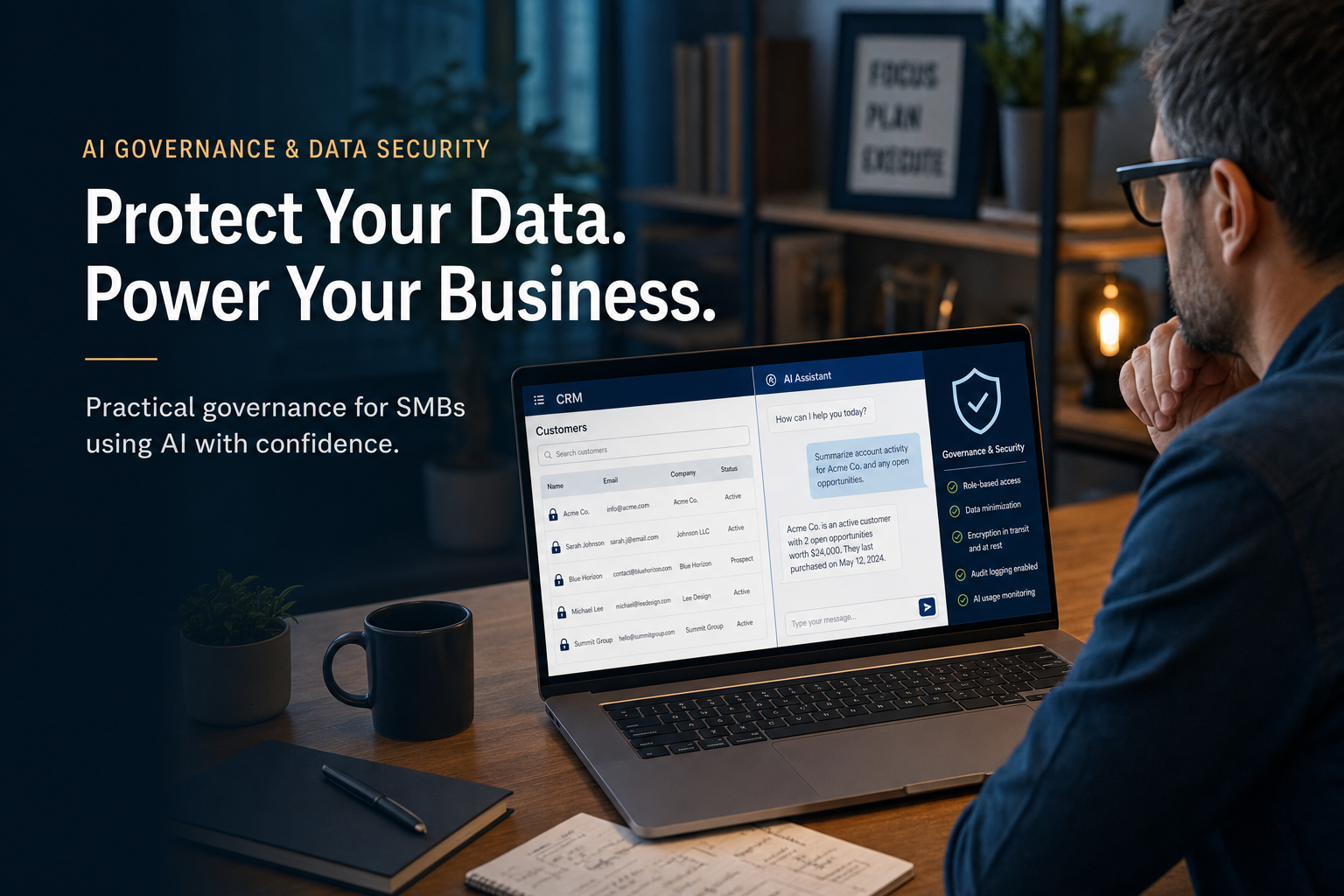
AI governance is written rules plus technical controls with one accountable owner, so your AI tools do not leak proprietary data or act outside approved boundaries. For most SMBs in 2026, governance is the real bottleneck to scaling automation safely. Adoption got easy. Oversight did not.
I build AI solutions through DialWise AI and TrainR, and I scope custom agent work for owners who already burned a weekend wiring ChatGPT to their CRM. Military intelligence and QA roles taught me to treat data exposure like a breach waiting to happen. This piece is what I require before any client scales AI past a pilot, as of June 2026.
What Is AI Governance and Why Is It the Bottleneck in 2026?
AI governance means documented policies plus enforced technical limits on what your AI can access, store, and output. It covers approved tools, data handling rules, human sign-off on high-risk actions, and audit trails. Without it, every new automation is a gamble on whether customer lists, pricing logic, or internal notes end up in the wrong model context.
The adoption numbers explain the gap. Vistage's Spring 2026 CEO survey of 1,302 U.S. SMB leaders found 84% have deployed generative AI, but only 22% have a comprehensive governance policy in place. RSM's January 2026 Cybersecurity Special Report, covering 501 middle market executives, found only 35% use formal AI governance frameworks while AI rollout accelerates across operations.
Owners call me when the pilot works and the fear kicks in. Can we connect the rest of the database? What if a rep pastes a client contract into a free chatbot? Who owns the mistake when the agent books the wrong slot? Governance answers those questions before they become incidents.
This is not a SOX audit guide or a Fortune 500 compliance manual. It is practical AI data security for business owners who want revenue workflows without betting proprietary data on default SaaS settings.
What Happens When You Connect AI to Your CRM or Database?
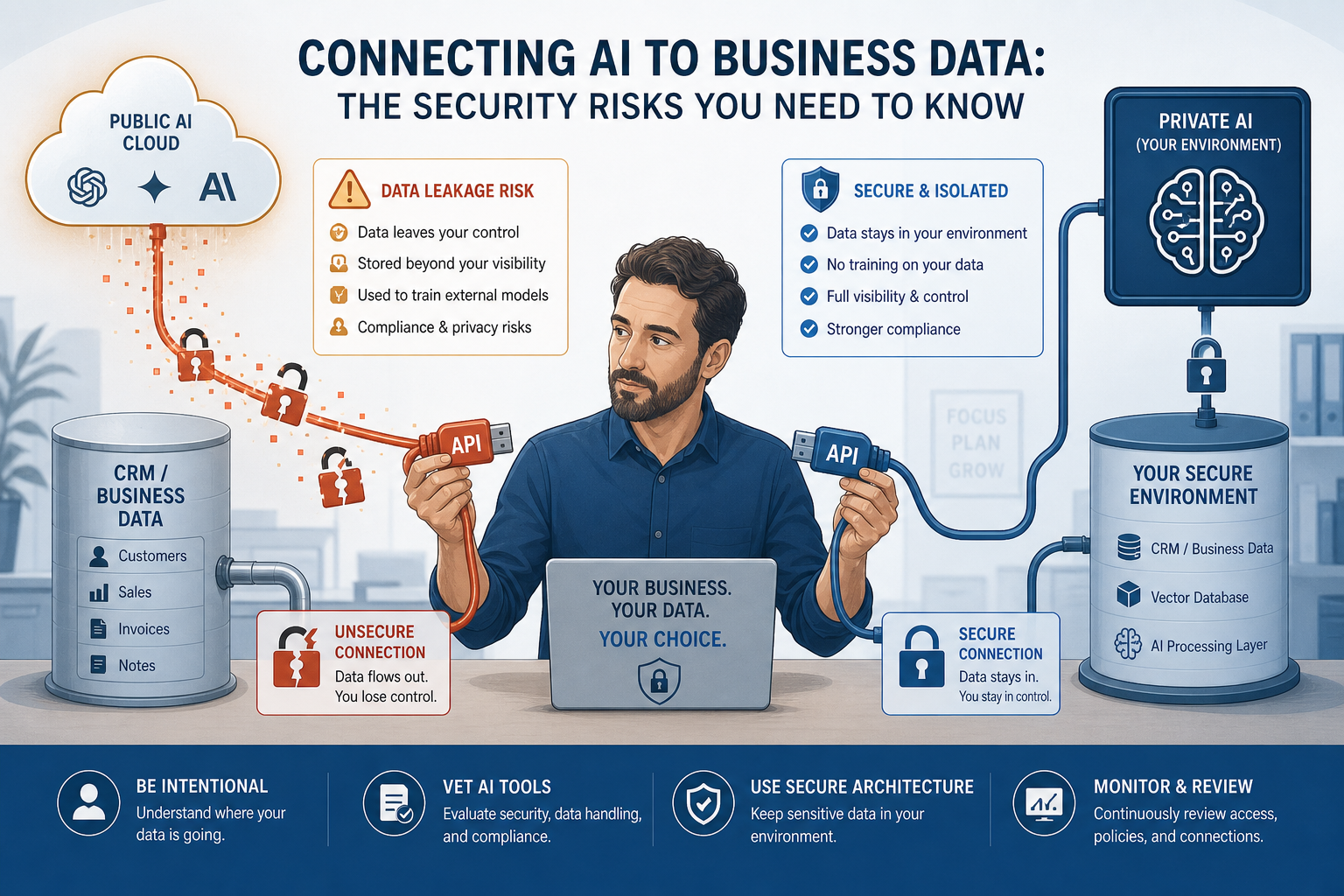
You expand the blast radius of every record the AI can read. A CRM connection gives the model customer names, deal values, notes fields, and sometimes attachments. If that pipeline lacks isolation, retention limits, and output filtering, you have turned your customer database into training context for a shared platform.
According to UpGuard's 2025 shadow AI survey of 1,000 employees globally, 81% use unapproved AI tools regularly. Writer's 2026 enterprise research found 67% of executives believe their organization already suffered a data leak through unapproved AI tools. The leak often starts innocent. A sales rep exports a lead list to summarize in ChatGPT. An ops manager uploads a pricing sheet to speed up a proposal. Each upload is data leaving your controlled perimeter.
IBM reported in 2025 that 97% of organizations breached through AI models or applications lacked proper AI access controls at the time of the incident. That stat sticks with me because it is preventable. The failure mode is almost always access that is too broad, not hackers in hoodies.
Before I wire any AI automation workflow to a live CRM, I map three questions with the owner. What fields does the agent truly need? Who can trigger it? What happens to prompts and responses in logs? If you cannot answer all three, pause the integration.
Is Shared-Database AI SaaS Safe for Proprietary Business Data?
Usually not for sensitive proprietary data, and the marketing page rarely spells out why. Many AI SaaS products run multi-tenant architectures where customer data shares infrastructure. Encryption at rest helps. It does not stop your data from becoming retrieval context for another tenant if the application layer is poorly isolated.
The risk spikes when vendors fine-tune models on customer content or pool embeddings across accounts. Your pricing playbook could influence a response generated for a competitor in the same vertical. Even without malice, co-mingled vector stores create leakage paths that single-tenant isolation removes.
I tell clients to read the data processing terms like they read a lease. Look for training opt-out language, subprocessor lists, retention windows, and whether your content can improve models for other customers. If the answer is vague, treat the tool as public-channel only. Drafting marketing copy is fine. Uploading signed contracts is not.
For SMBs racing to automate, the faster path is often a dedicated stack where your data stays in your database and the model only reads through controlled retrieval. That is the architecture I use on custom AI agent builds when compliance or competitive secrecy matters.
RAG vs Fine-Tuning: Which Protects Your Data Better?
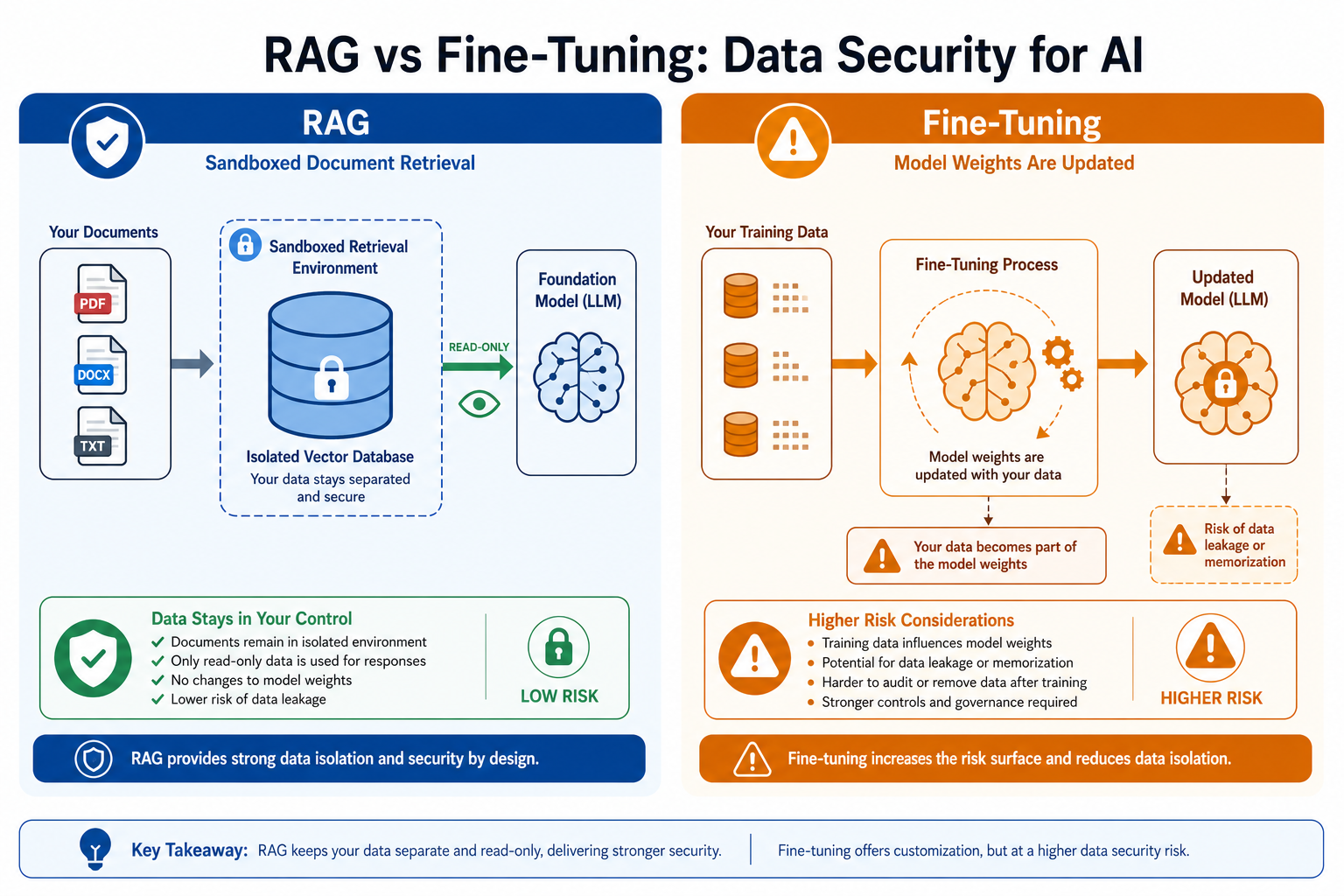
Retrieval-Augmented Generation (RAG) is safer for most SMB use cases because your proprietary data stays in a sandboxed store and the model reads it at query time without permanently absorbing it into weights. Fine-tuning changes the model itself. That raises governance overhead, retraining cycles, and the stakes of any data misclassification.
Use this table when an vendor or integrator asks which path to take.
| Approach | How data is used | Leakage risk profile | Best for |
|---|---|---|---|
| RAG with isolated DB | Documents retrieved per query, not baked into weights | Lower when access controls and filters are tight | Support bots, internal Q&A, proposal assistants |
| Fine-tuning on your data | Training examples update model behavior | Higher, mistakes in dataset selection are permanent until retrain | Narrow tasks with curated, non-sensitive datasets |
| Prompt-only (no retrieval) | Data sent in the prompt each call | Medium, depends on logging and vendor retention | One-off drafting with no CRM connection |
| Shared SaaS embeddings | Your files indexed beside other tenants | Higher for competitive or regulated content | Low-sensitivity content only |
I default to RAG on per-client isolated databases for TrainR and DialWise-adjacent projects. Fine-tuning is a deliberate decision, not a default, and I avoid it when the dataset includes customer PII or unreleased pricing. If someone pitches fine-tuning as the premium option without a risk conversation, that is a sales tactic, not governance.
How Do I Build AI Governance Without a Big Legal Team?
Start with a minimal viable framework you can enforce this month. You do not need a 40-page policy. You need five decisions written down and backed by one technical control each.
- Publish an acceptable use policy. List approved tools, banned uploads (contracts, HR files, raw exports), and the rule that customer data stays out of public chatbots. Vistage found acceptable use guidelines are the most common component among SMBs that have any policy at 87%.
- Assign one accountable owner. Not a committee. One person signs off on new AI integrations and reviews incidents. RSM's 2026 data shows only 44% of middle market firms have defined AI decision roles, which is why governance stays fragmented.
- Segment data by sensitivity. Public marketing copy, internal SOPs, customer PII, and financial records get different tools and different access. If everything is treated the same, nothing is protected.
- Log prompts and outputs for connected systems. You cannot investigate a bad booking or a weird email if nothing was recorded. Retention can be 30 to 90 days. Zero logging is not governance.
- Run a quarterly shadow AI audit. Ask each department what they pasted into free tools last month. UpGuard's 81% shadow AI usage rate means the honest answer will surprise you.
Map this to the NIST AI Risk Management Framework if you want a respected external scaffold. You do not need to implement every function on day one. You need a repeatable habit before you add the fifth automation.
Owners who already automated lead follow-up from my AI automation for small business guide should add governance at the CRM connection step, not after a leak.
What Security Controls Actually Matter for Custom AI Agents?
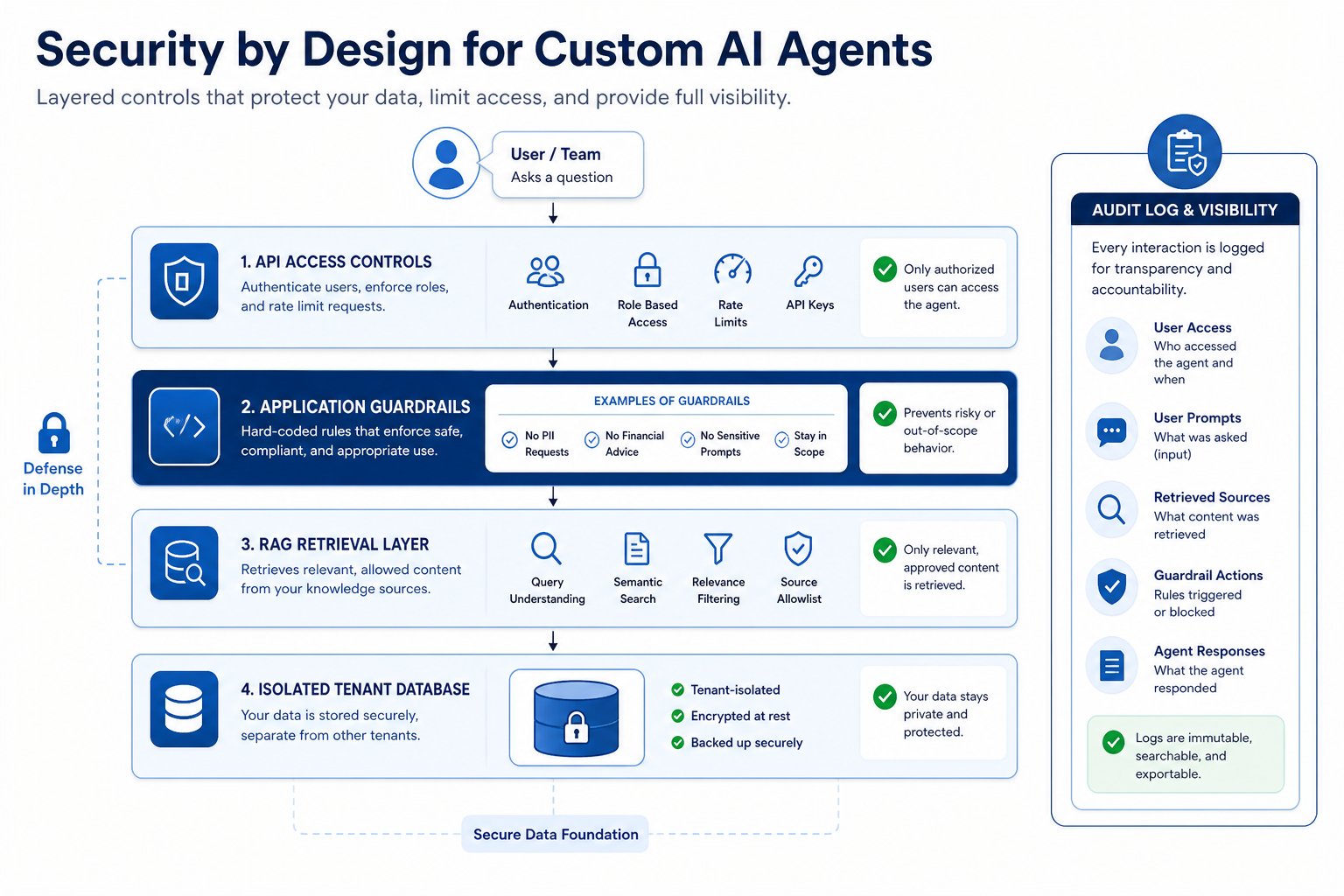
The controls that matter are boring and specific. Fancy dashboards do not replace isolation, scoped retrieval, and hard guardrails the model cannot talk its way around.
| Control | What it does | Why SMBs skip it |
|---|---|---|
| Tenant-isolated database | Each client data store is separate, no shared embeddings | Cheaper SaaS pools resources |
| Scoped RAG collections | Agent only queries approved document sets per role | Faster to dump the whole drive in one bucket |
| Application-layer guardrails | Code blocks disallowed actions regardless of prompt tricks | Teams trust the model to behave |
| Role-based API access | Service accounts with least privilege to CRM and calendar | Admin keys are easier to wire once |
| Output filtering | Strip PII patterns, block external email domains on drafts | Adds latency and testing time |
| Human-in-the-loop on high impact | Quotes, refunds, and bulk sends need approval | Owners want full automation day one |
On agent projects I ship, guardrails live in code, not in the system prompt alone. Prompts drift. Code does not. Example: an agent cannot mark a deal closed-won if the quote total exceeds a threshold without a human click. Example: retrieval calls fail closed if the user role does not match the document tag.
RSM's 2026 report lists the controls middle market firms actually use today. Staff training on responsible AI leads at 51%. Formal data governance policies sit at 46%. Training is necessary. Training without technical enforcement is a memo, not a control.
If you are evaluating whether to DIY or hire someone, read how Dallas SMBs are adopting AI for the operational context. Governance sits on top of those same workflows.
When Should You Hand Governance to Someone Who Has Done It Before?
When the pilot touches live customer data, syncs write access to your CRM, or faces a prospect who asks about your data handling in the sales cycle. That is the line between experimentation and liability.
You can absolutely draft an acceptable use policy yourself. You can turn off training in ChatGPT Team. You can block shadow AI with DNS rules. The slow part is designing isolation, retrieval scopes, and guardrails that survive edge cases. That is where owners lose a quarter.
I am Etai Fishler. I have spent 13 years in sales and marketing and the last two shipping AI that drives ROI for SMBs. I scope governance in the same discovery call where we name the revenue metric. If the architecture cannot pass a basic data isolation test, we do not scale it.
Book a free 20-minute AI opportunity audit if you want a ranked plan: what to lock down now, what to automate next, and what to leave alone until your policies catch up. No fear deck. Just the controls that match your data.
FAQ: AI Governance and Data Security
What is AI governance for a small business?
It is the combination of written policies and enforced technical limits on what your AI tools can access, store, and send. For most SMBs that means an acceptable use policy, an assigned owner, approved tools only, and logging on connected systems. Vistage's Spring 2026 survey found only 22% of SMB CEOs have a comprehensive policy despite 84% deploying generative AI.
Is it safe to connect AI to my CRM?
It is safe when access is read-scoped to required fields, data stays in an isolated environment, outputs are filtered, and high-impact actions need human approval. It is unsafe when you paste exports into public chatbots or grant write access without guardrails. IBM reported in 2025 that 97% of organizations breached via AI lacked proper access controls.
RAG or fine-tuning: which is better for data security?
RAG with an isolated database is safer for most SMB workflows because proprietary content is retrieved at query time instead of baked into model weights. Fine-tuning is appropriate only when you have a curated, reviewed dataset and a plan to retrain when data changes.
What is shadow AI and why does it matter?
Shadow AI is employees using unapproved AI tools for work tasks. UpGuard's 2025 survey found 81% of employees use shadow AI regularly. That bypasses your policies and often sends sensitive data to vendors you never vetted.
How much AI governance does an SMB need before scaling?
At minimum: acceptable use rules, one accountable owner, segmented data classes, logging on connected automations, and tenant isolation if customer data is in the loop. You can expand from there. You cannot unwind a leak after you scale.